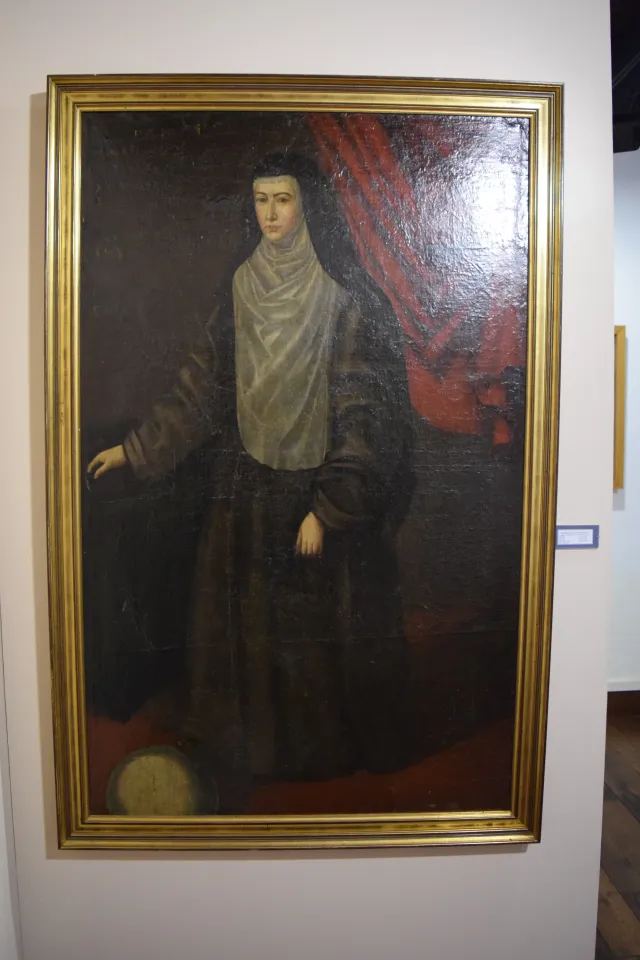
Portrait of Soror Catalina de la Concepción
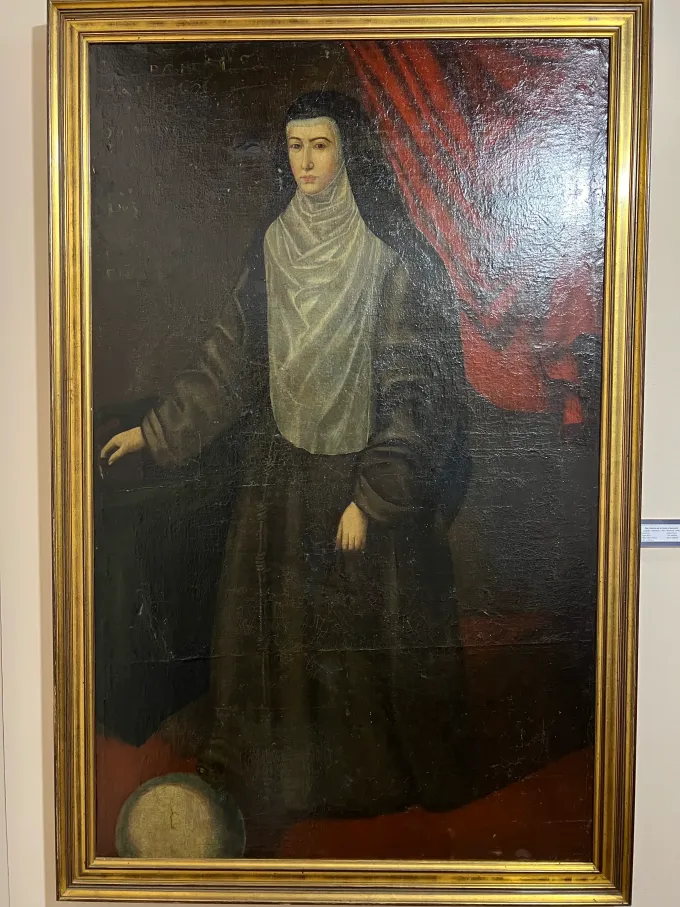
This piece is an oil painting on canvas that represents Doña Catalina de la Cerda y Sandoval, Countess of Lemos, Vicereine of Naples, and founder of the Convent of the Poor Clares of the Purísima Concepción of Monforte de Lemos. The lady portrayed appears already under the religious identity of Soror Catalina de la Concepción, the name adopted upon her entry into the Poor Clares community in 1633. The work, executed after that date and before her death in 1648, constitutes a fine example of the models of female conventual portraiture from the first half of the 17th century.
The figure is portrayed standing, in a frontal position and slightly turned, dressed in the full habit of the order: brown tunic, white wimple, black mantle, and cord with five knots, symbol of the Franciscan profession. In her right hand she holds a prayer book resting upon a small table, an element that underscores her dedication to devotional reading and spiritual exercise. The face, with mature features and a serene expression, transmits an intense sense of inner recollection, reinforced by the presence of a celestial globe at her feet which is an allegory of contempt for the world and renunciation of earthly vanities.
The scene takes place in a room of reduced dimensions which is defined by a tenuous illumination that concentrates upon the central figure. The crimson curtains framing the composition introduce an element of controlled theatricality, customary in Baroque portraiture, while also contributing to highlighting the presence of the woman being portrayed. The sobriety of the space, together with the absence of superfluous elements, reinforces the spiritual reading of the image and places the figure within a realm of withdrawal and contemplation characteristic of monastic life.
From a stylistic standpoint, the painting falls within the orbit of the Spanish Baroque school which is characterized by chromatic austerity, naturalism, and the marked devotional character of its compositions. Regarding authorship, the painting may be attributed to a workshop of the Castilian school with certain ties to conventual or noble circles. Likewise, this portrait forms a pair in the collection with the Portrait of the Duke of Lerma, father of the sitter, which reinforces its representative and dynastic function.
Finally, in the upper right corner, an inscription, now illegible, is preserved. It’s original content may have referred to the identity, virtues, or religious condition of the sitter.
- Chamoso Lamas, M. y Casamar, M. (1980). Museo de Arte Sacro Clarisas de Monforte de Lemos. Madrid: Caja de Ahorros de Galicia.
- Sáez González, M. (2018). Coleccionismo y almoneda del gran Conde de Lemos, Don Pedro Fernández de Castro. Lugo: Diputación de Lugo.