Pax of the Assumption
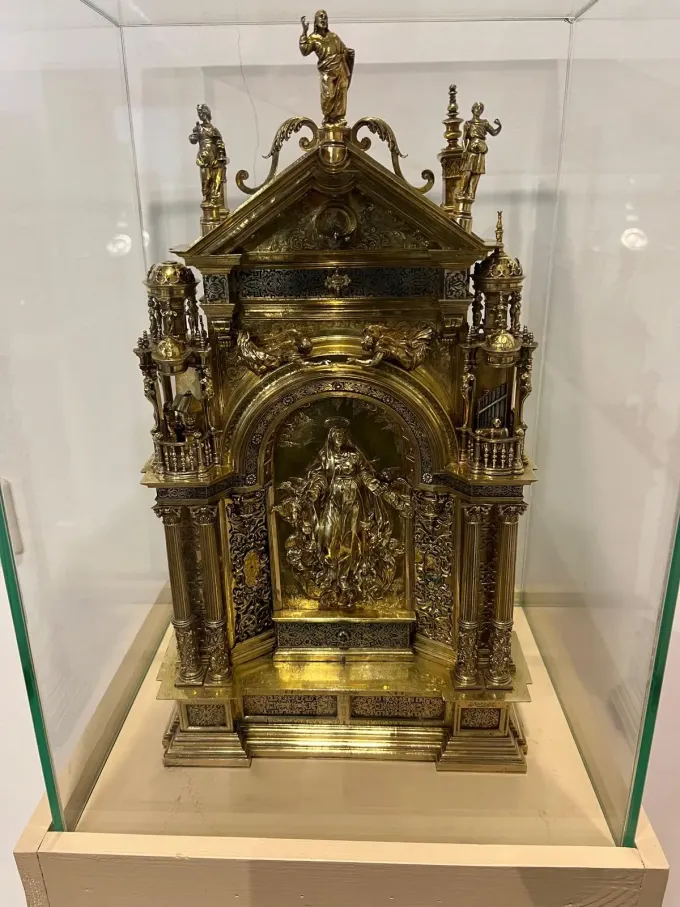
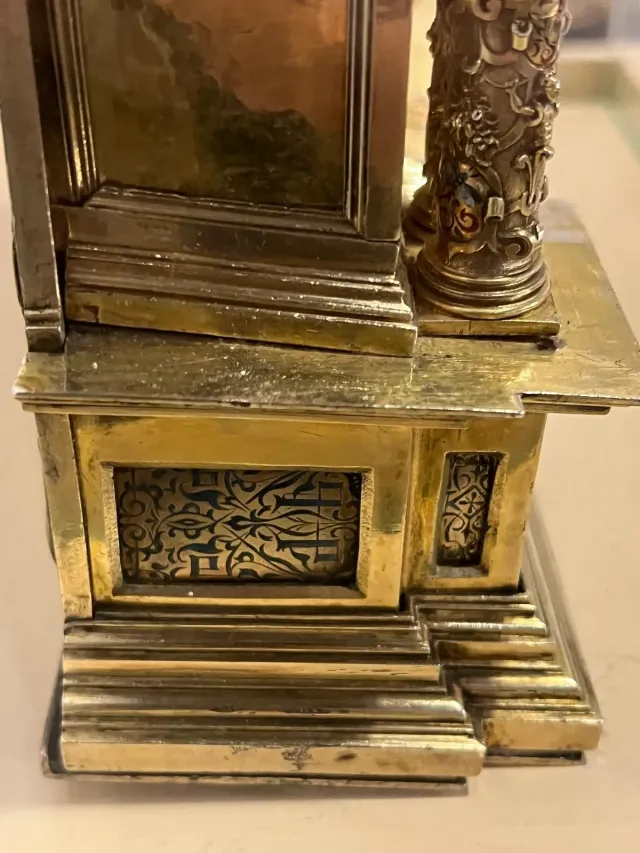
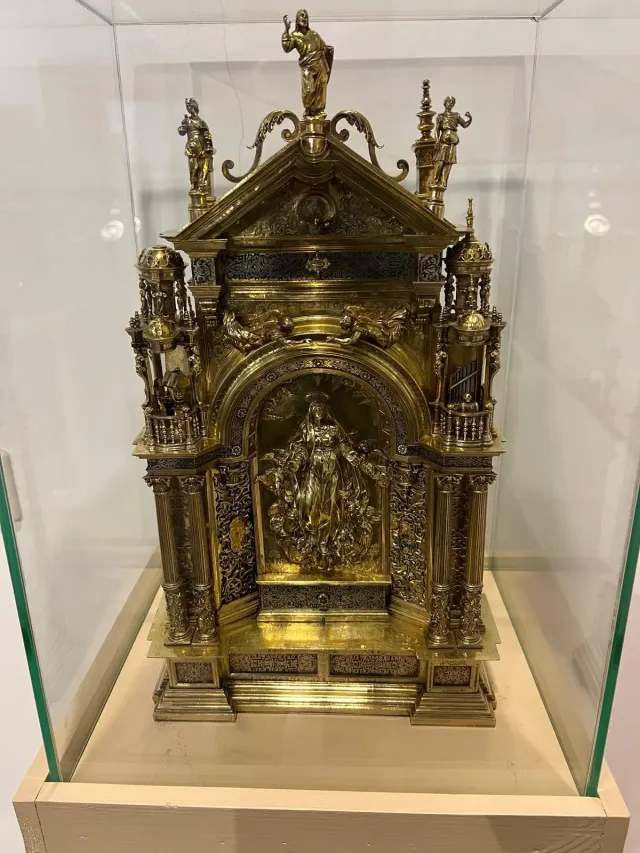
This piece is a pax of Mannerist aesthetic executed in over-gilded silver decorated with various enamel plaques. The piece follows a disposition similar to that of a small altarpiece, dividing its central body into three sections, the central one being wider than the lateral ones. Thus, upon a predella with projections on the sides and decorated with enamel plaques, a scene-like space unfolds, protected by the large semicircular arch at the top, which follows a scheme similar to that of a triumphal arch. In the center, the enamel plaque in the lower part acts as a transitional element toward an elaborate representation of the Assumption. In it, the Mother of God appears wrapped in a billowing mantle and propelled by cherubs in a marked upward movement. Likewise, the figure demonstrates a careful anatomical study of the female body, which, nevertheless, presents a slightly elongated canon of Michelangelo-inspired taste. Notable is the treatment of the draperies, which are carefully represented using the wet drapery technique. Moreover, the background appears slightly blurred, creating a sensation of depth, motivated by the use of sfumato as an expressive resource.
As mentioned above, the scene is framed by a large semicircular arch, composed of two lateral sections with candelieri decoration and central inlays of gemstones (now lost). Next, two pinnacles serve as the starting point for the great arch that envelops the scene, which features a kind of archivolt decorated with enamels and a sequence of rosettes. At the top, in the spandrels, two angels seem to hold the corresponding crown over the Virgin's head (now missing).
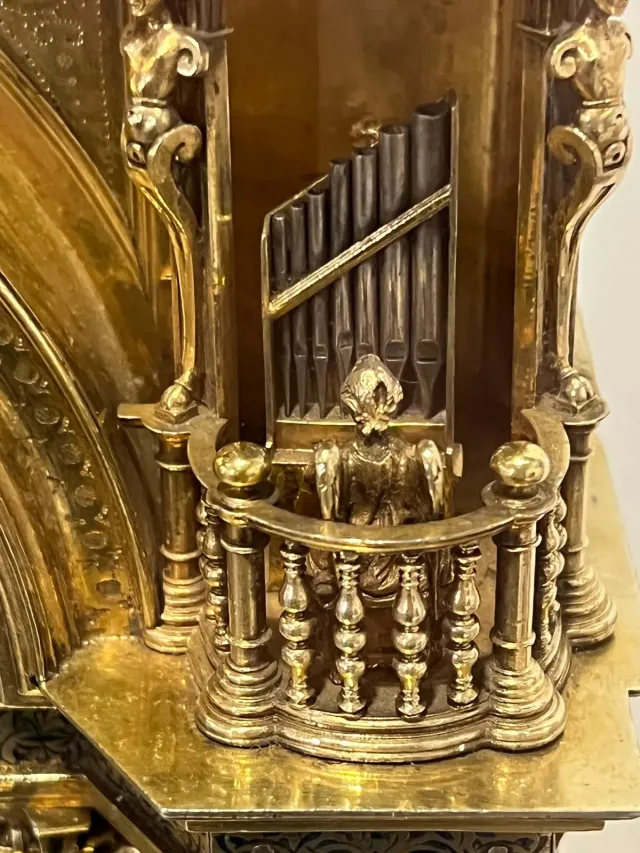
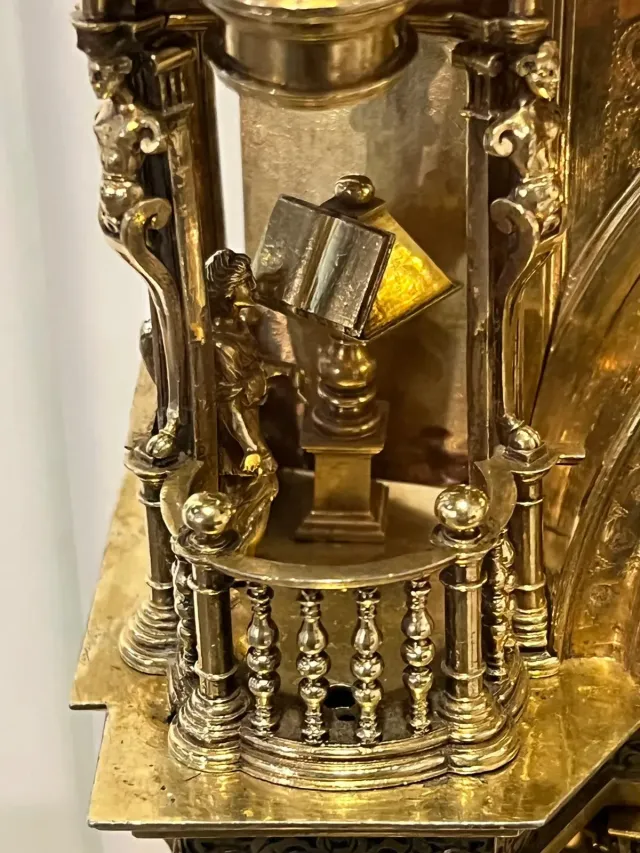
As for the lateral sections, the projection of the lower predella continues into the paired column ensembles, generating a great sense of spatial amplitude in the whole. These present fluted shafts and a lower section decorated with grotesques. They also feature Corinthian capitals that support a slender entablature extending toward the aforementioned arch. Above it, on both sides, appear two small balustraded balconies enclosing an organ on the right and a lectern with a hymn book on the left. This space is protected by twin double templets supported by an ascending sequence of stipes and caryatids, respectively.
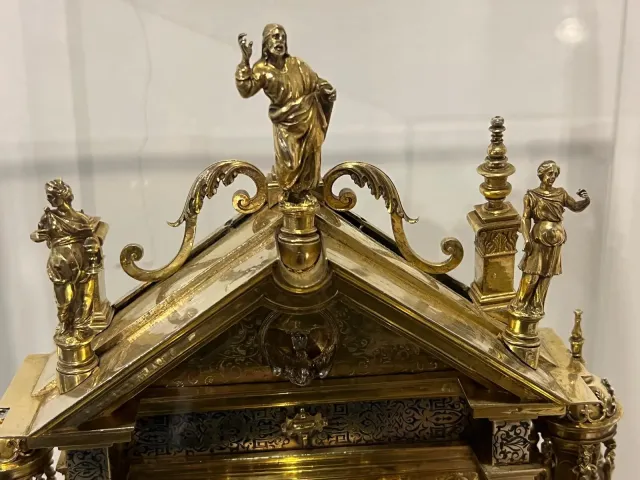
At the top, a frieze with a long enamel plaque gives way to the crowning pediment, which contains in its center a medallion with a dove, symbol of the Holy Spirit. At each vertex of the triangle, three figures: two female figures on the sides, symbols of the old and new law, and a central one, representing Christ blessing between two fine volutes.
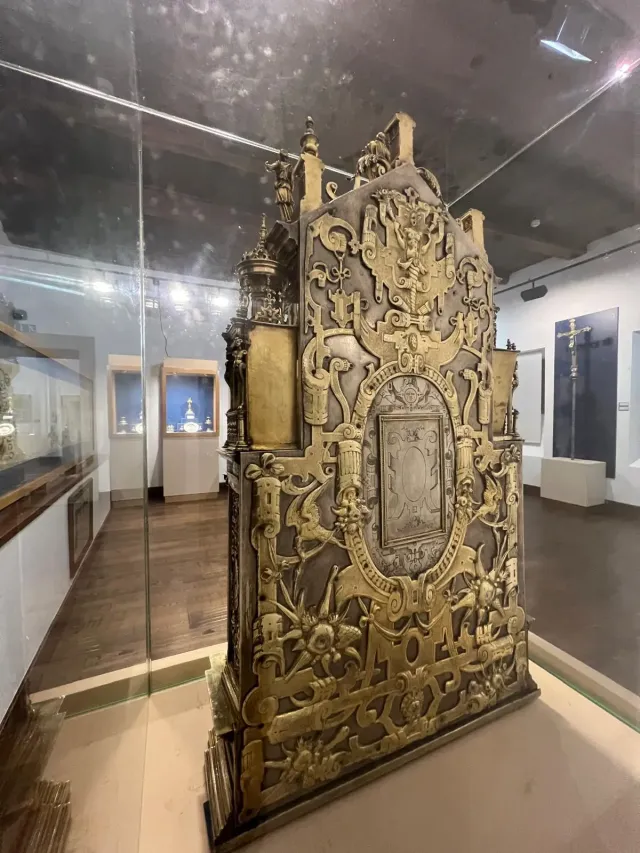
The reverse presents a more complex decoration, in which a large candelieri motif serves as support for a crowned figure that refers us to the models of the Sol Invictus of Roman Antiquity.
- Chamoso Lamas, M. y Casamar, M. (1980). Museo de Arte Sacro Clarisas de Monforte de Lemos. Madrid: Caja de Ahorros de Galicia.
- Sáez González, M. (1987). La platería en Monforte de Lemos. Lugo: Diputación de Lugo.