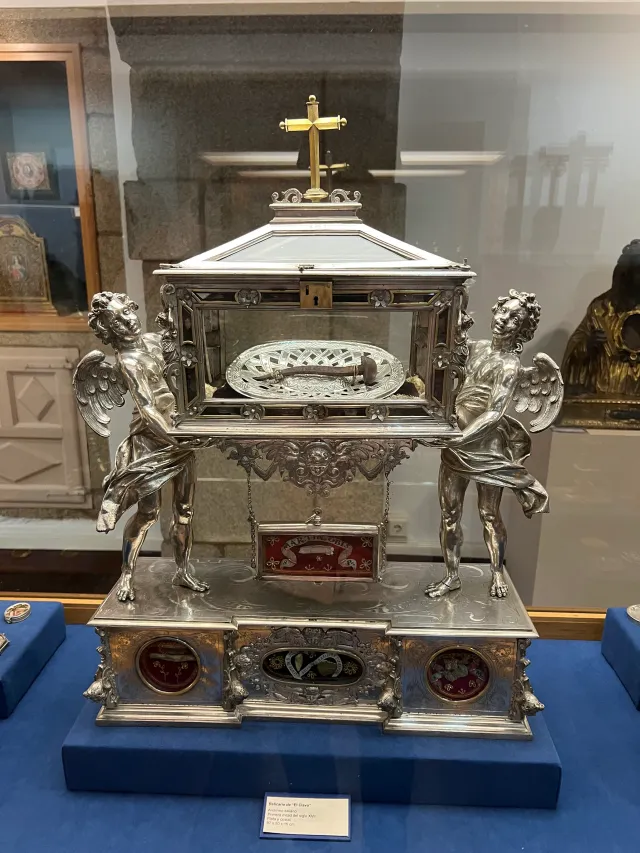
Reliquary Urn of the Holy Nail
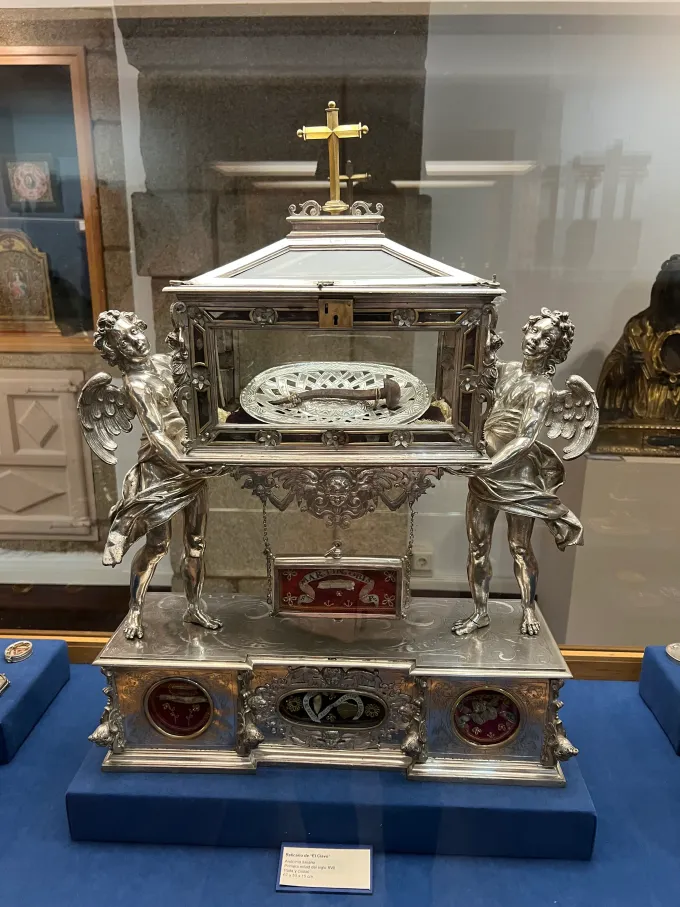
This piece is a reliquary urn made of silver and glass which contains the relic of one of the nails from the Crucifixion. The ensemble wisely and harmoniously integrates elements of diverse nature. Thus, in the upper part, there is a rectangular urn with a truncated pyramidal lid, made from a silver structure and enclosed with glass sheets. This model shows certain parallels with the reliquary caskets preserved in the collection, yet showing an evident greater richness of materials. The upper lid maintains the lateral glass panels that allow one to see the contents of the box, while at the uppermost end the finial element is crowned by a Latin cross made of over-gilded silver.
As for the transparent box, it allows one to see the relic it contains within: one of the nails from the Crucifixion of Christ. This said element rests upon a silver tray, which is decorated with an interlace composed of a double sequence with zigzag-braided bands, and whose base shows a decoration of floral motifs. Otherwise, the nail is attached to this element by two cords positioned at the ends, the lower of which features several small seed pearls. Moreover, the structure of the urn displays an elegant decoration that combines the structural element of uncolored silver, small glass sheets with over-gilded silver moldings, six-petaled flowers, and four anthropomorphic pilasters attached to the corners, also made of silver. Likewise, this main box presents, on the lower front, a decorative element presided over by the image of a small angel, which also acts as a supporting element for a small reliquary frame held by chains, guarding the relics of Saint Martin (obverse) and Saint Clement (reverse), identified in both cases by their respective cartouches.
The ensemble formed by the urn and the reliquary frame appears supported by two beautifully crafted silver angels. Both figures show great concern for anatomical study and movement. Thus, we are faced with two angels of youthful appearance and well-proportioned bodies, which reveal attention to detail. Notable is the care shown by the artist in aspects such as the expression of the faces, the curvature of the wings, and the amplitude of the mantles, a dynamic tension that translates into a diagonal that helps soften the rigidity of the straight forms that dominate the piece.
Furthermore, both angels rest upon a molded pedestal of almost rectangular section that presents a slight setback on the front part. In its upper space, where the two large angels move, the piece shows floral decoration engraved with a burin. As for the intermediate part, it presents at the corners a series of decorative elements of identical workmanship, formed by cherubs accompanied by a kind of volutes with small beads. On the front, this lower box contains several relics identified by cartouches. Thus, in the central recessed space, flanked by a decoration composed of four small angels, an oval reliquary box guards the relics of Saint Julian (a tooth) and Saint Basilissa. Meanwhile, on the more advanced lateral bodies, two circular reliquary boxes similarly serve for the deposit of relics.
Lastly, it should be noted that this piece may have constituted a gift from the VIII Count of Lemos, Francisco Ruíz de Castro, to Catalina de la Cerda y Sandoval. The urn is cited in the convent's documentation:
En una arquilla de cristal guarnecida de plata está un clavo de los con que enclavaron á Cristo nuestro Señor en la Cruz, que se le dieron al Padre fr. Agustín de Castro siendo Embajador en Roma, y la certificación está en el Archivo, de su misma letra y mano (Monforte de Lemos, Archivo del Convento de Santa Clara, papeles sueltos, 3r. apud Sáez González, 1987: 211).
- Chamoso Lamas, M. e Casamar, M. (1980). Museo de Arte Sacro Clarisas de Monforte. Madrid: Caja de Ahorros de Galicia.
- Lorenzana Lamelo, M.ª L. (1986) Aportación documental al estudio histórico-artístico de dos fundaciones monfortinas: el colegio de la Compañía y el Convento de las Clarisas. Santiago de Compostela: Universidad de Santiago de Compostela.
- Sáez González, M. (1987). La platería en Monforte de Lemos. Lugo: Diputación de Lugo.
- Valle Pérez, J. C., y Fernández Otero, J. C. (1993). Os Museos da Igrexa en Galicia. Ourense: Xunta de Galicia.