The Immaculate Conception with the Seven-Headed Hydra
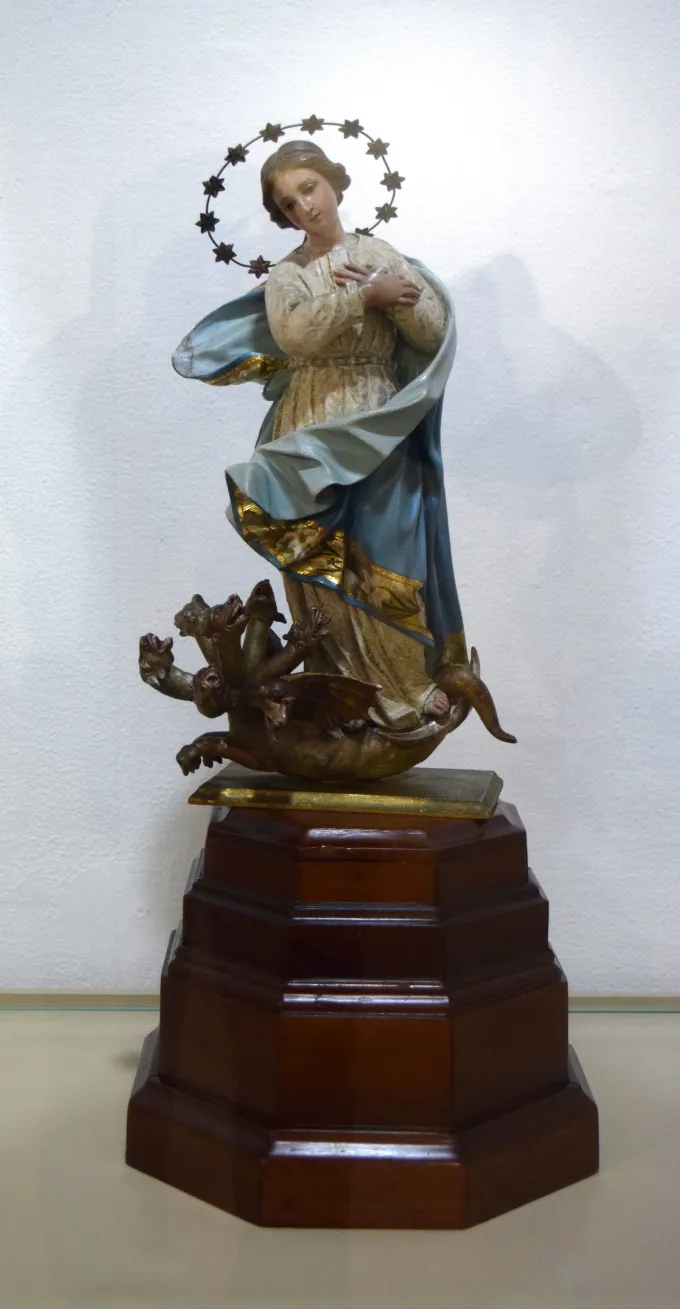
This piece is a polychrome wood sculpture that represents an Immaculate Conception treading upon the Seven-Headed Hydra. In this case, the bestial figure at the Virgin's feet adopts a monstrous form: a hybrid creature with a dragon's body from which seven heads emerge, one of them is crowned. Upon it, the Virgin steps forward with her left foot, supported by a small lunar crescent. Mary is represented wearing a white tunic, with her arms crossed over her chest and covered by a beautiful blue mantle. It acquires great breadth, giving the sensation of being animated by the wind in its upward movement. The figure, with a serene face, shows her head tilted to the right, while a crown composed of twelve six-pointed stars completes the ensemble.
Part of the richness of this work resides in its excellent polychromy. The dark tones that decorate the beast (primarily earthy and green) contrast with the purity transmitted by the image of the Immaculate Conception. Thus, Mary is shown with a white tunic which, through crossed tones, simulates silk lace. As for the mantle, blue in color, it constitutes the element of greatest richness. Notable is the band that adorns the lower part of the garment, in which a beautiful gilded border decorated with a lily flower pattern can be observed, thereby emphasizing the Virgin Mary's virginity.
Otherwise, the work is cited in a document from the year 1690: “Una Ymagen de Ntra Sra de la Concepcion sobre un Monte con la Ydra de siete cabezas, y el Aguila la cual estaua reconocida y estimada…” (Monforte, Archivo del Convento de Santa Clara, P. I. N. 1r.).
This documentary citation allows us to discern a possible lack of fit between the base of the piece and the pedestal on which it currently stands. This lack of correspondence suggests the existence of another, original pedestal, which would have displayed the aforementioned “Mount”.
- Lorenzana Lamelo, M.ª L. (1986) Aportación documental al estudio histórico-artístico de dos fundaciones monfortinas: el colegio de la Compañía y el Convento de las Clarisas. Santiago de Compostela: Universidad de Santiago de Compostela.
- Sáez González, M. (2012). Del Reino de Nápoles a las Clarisas de Monforte de Lemos: escultura del siglo XVII en madera. Lugo: Diputación de Lugo.