Holy Burial
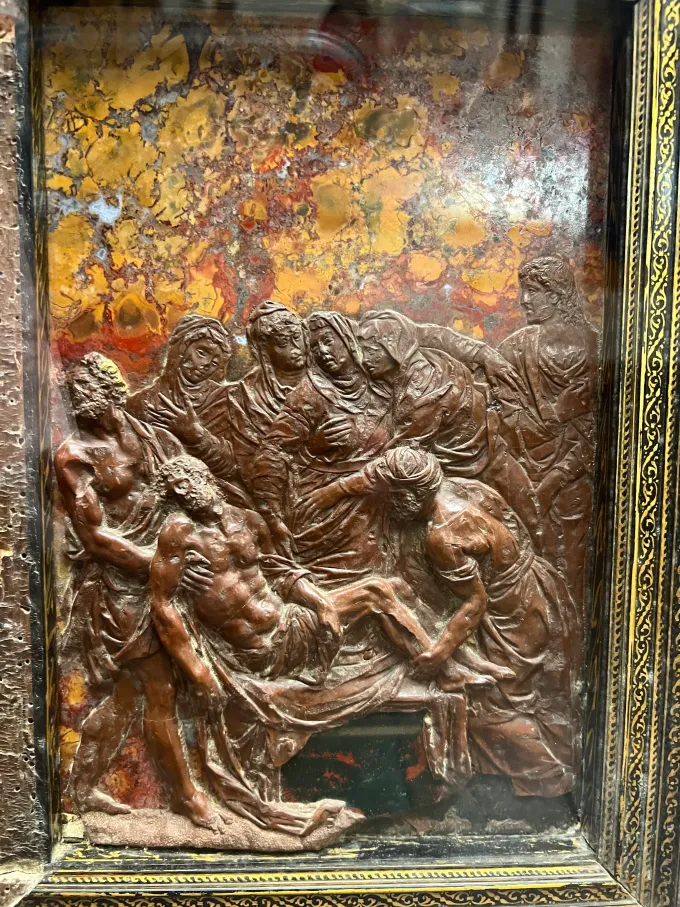
This piece represents the Holy Burial executed in polychrome wax upon a jasper base. The scene presents a group of interconnected figures, among which the central figure of Christ stands out. He is already deceased and his body is shown supported by Saint John and Nicodemus. In the background group, the image of a sorrowful Mary stands out above the remaining figures. On either side, Mary of Cleophas and Mary Magdalene support the Virgin while accompanying her in her grief, all of this in the presence of two other figures at the ends.
The composition is divided into two distinct registers, determined by the very arrangement of the figures. On the one hand, in the upper group the figures appear intimately linked together and maintain an isocephalic arrangement. In the lower section, the three figures follow the diagonal marked by the body of Christ, thus granting a certain depth and a more dynamic character to the scene.
This latter aspect is undoubtedly reinforced by the tension in the movements of the two men who support the Savior, as well as by the various expressions of grief reflected on the faces of the other figures. Moreover, the author uses the technique of “wet drapery” in the garments, which undoubtedly reinforces the sculptural quality of this bas-relief.
In the background of the scene, the chromatic nature of the jasper offers a highly effective resource for heightening the dramatic tension of the moment represented, thus adding a twilight atmosphere that harmonizes with the reddish tone of the figures.
Finally, the work is completed by a frame made of ebony, adorned with gilded tones, from which the right lateral piece is missing.
-
Andrés González, P. (2020). “De convento a museo. Las colecciones de patronazgo femenino entre las clarisas”, en Ángel Zalama, M. e Andrés González, P. (eds.), Ellas siempre han estado ahí. Coleccionismo y mujeres. Madrid: Ediciones Doce Calles, pp. 95-111.
-
Chamoso Lamas, M. y Casamar, M. (1980). Museo de Arte Sacro Clarisas de Monforte de Lemos. Madrid: Caja de Ahorros de Galicia.
-
Sáez González, M. (2018). “El VII Conde de Lemos transmisor del arte italiano en Galicia”, en Cruz Valdovinos, J. M. e Cañestro Donoso, A. Scripta artium in honorem prof. José Manuel Cruz Valdovinos. Alicante: Universidad de Alicante, pp. 740-749.