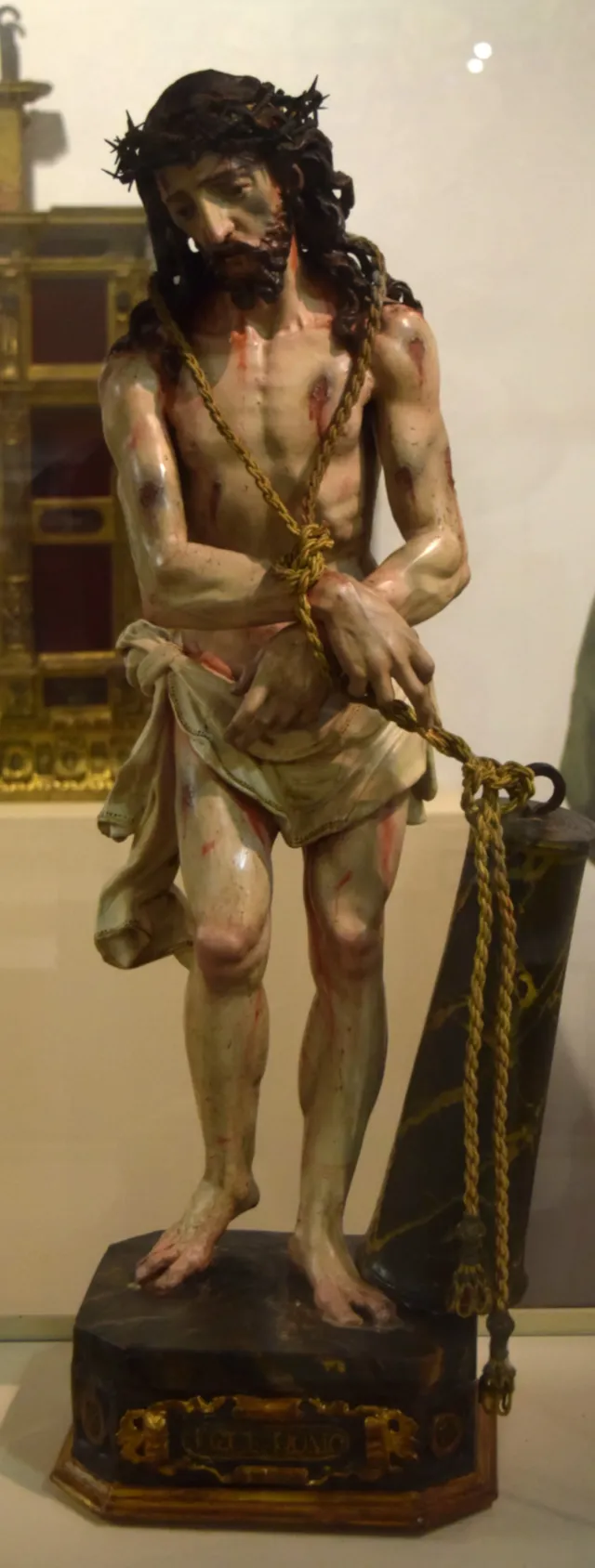
Ecce Homo
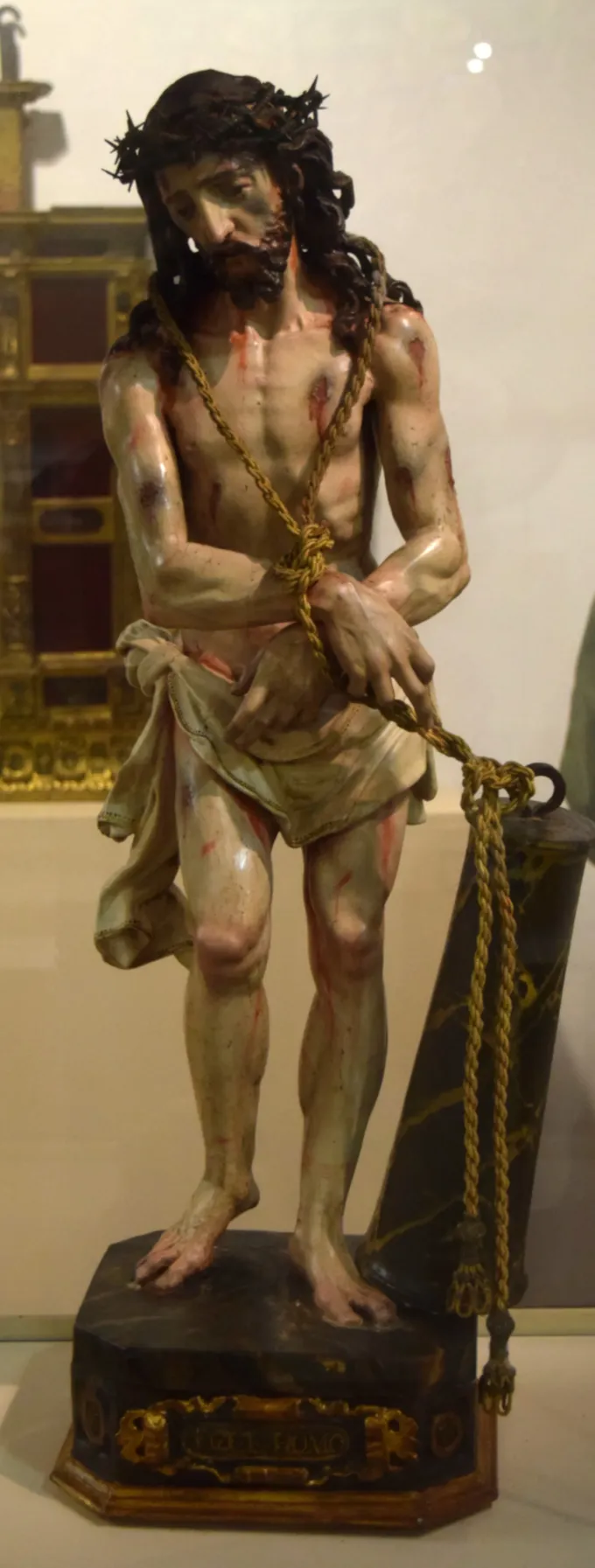
This piece is a full-length figure of Christ according to the iconography of the Ecce Homo. It portrays the Divine Savior represented tied to the column, with a fragment of real rope, and at a moment subsequent to the flagellation, in which the marks of pain from the martyrdom are still fully visible. The wounds and lacerations of the body were masterfully executed by the artist. The piece shows a perfect anatomical study and a remarkable psychological capture of the suffering endured, reflected in the face of Christ.
The scene alludes to the moment narrated in the Gospel of John, in which Pilate exclaims: “Behold the man” (John 19:5). The artist describes an episode in which the punished body of Christ becomes the great protagonist, reducing the size of the flagellation column to a minimum. Despite its rawness, the work maintains a perfect balance motivated by the elegant position of the body, slightly tilted with one foot forward.
As for the pedestal, it presents a slightly polygonal shape and shares the same decorative pattern as the column it supports, executed with marble-like tones. A cartouche on its front allows the piece to be identified by the inscription: “ECCE HOMO.”
Otherwise, it should be noted that the piece, given the arrangement of its elements, shares a certain connection to the Christ tied to the column in the Almudena Cathedral in Madrid which is a work by the Neapolitan artist Giacomo Colombo. However, even more revealing is its similarity to another Madrid model. In this case, it is the Christ tied to the column by Gregorio Fernández that belongs to the Royal Collections, Royal Monastery of the Incarnation (cf. Arias Martínez, 2024: 227).
- Arias Martínez, M. (2024). Darse la mano. Escultura y color en el Siglo de Oro. Madrid: Museo Nacional del Prado.
- Chamoso Lamas, M. y Casamar, M. (1980). Museo de Arte Sacro Clarisas de Monforte de Lemos. Madrid: Caja de Ahorros de Galicia.
- Lorenzana Lamelo, M.ª L. (1986) Aportación documental al estudio histórico-artístico de dos fundaciones monfortinas: el colegio de la Compañía y el Convento de las Clarisas. Santiago de Compostela: Universidad de Santiago de Compostela.
- Sáez González, M. (2012). Del Reino de Nápoles a las Clarisas de Monforte de Lemos: escultura del siglo XVII en madera. Lugo: Diputación de Lugo.