Crucified Christ
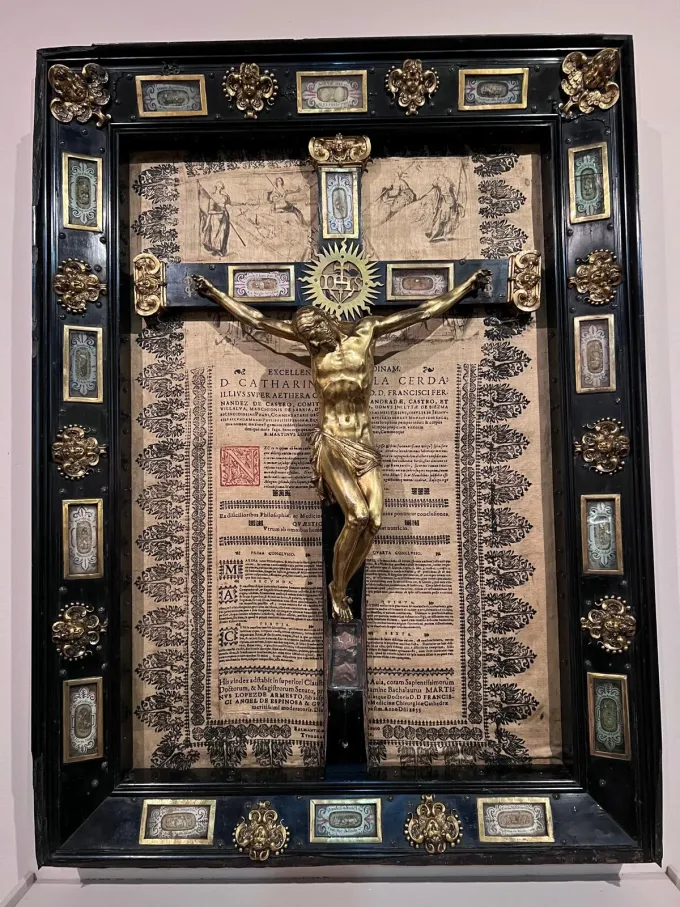
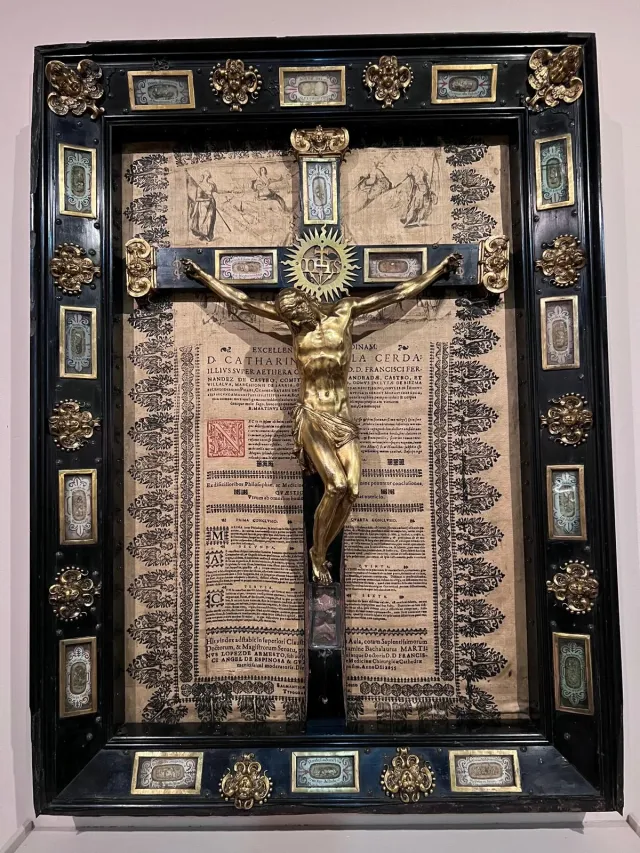
This piece is a large reliquary frame containing within it the bachelor theses of Catalina de la Cerda y Girón. She was a Poor Clares nun of the convent and the daughter of the IX Count of Lemos, as well as a crucified bronze figure by the Italian artist Guglielmo della Porta. The structure is made from a molded ebony frame, with an alternating succession of rectangular reliquary compartments and bronze appliqués with cherub heads.
As for the relics, these are protected by glass plates and each has its own identifying cartouche edged with decoration based on blue and red lines. Inside this structure, in the background, appears the yellow silk fabric engraved with the six theses for obtaining the bachelor's degree in Philosophy and Medicine of Catalina de la Cerda y Girón, defended in the year 1655. As indicated on the lower part of the fabric, the engraving was executed by the Salamancan publisher and printer Diego de Cossío.
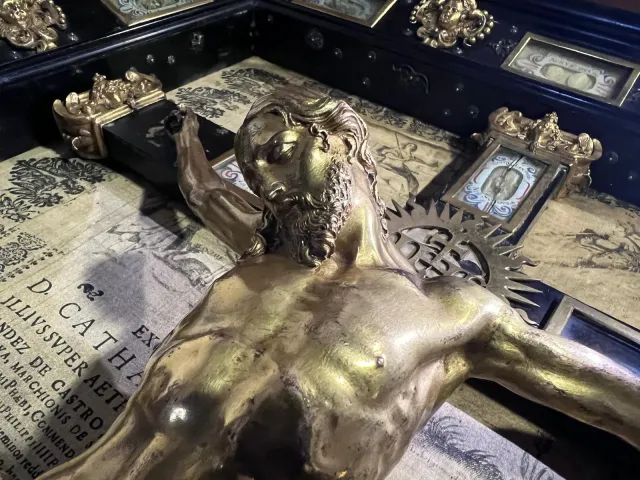
In this ensemble, the inclusion of the bronze figure of the Crucified stands out and it was executed by the Italian artist Guglielmo della Porta. It is an image of Christ crucified in gilded bronze upon an ebony reliquary cross. The layout of the cross is resolved by means of a central bronze piece at the intersection of the crossbars, which presents a radiant aspect and is presided over by the monogram “IHS” crossed by a small cross and the three nails of the crucifixion as part of the Arma Christi.
As for the crossbars, these feature a finish with gilded bronze appliqués depicting cherubs amid volutes at the ends and glass-covered reliquary compartments in the intermediate spaces. In this regard, it is important to note that, on the lower part of the central crossbar, the piece has a metallic element that serves as a support. Moreover, in that same section, the absence of a reliquary compartment intended for the deposit of relics, which would have occupied that space, is observed.
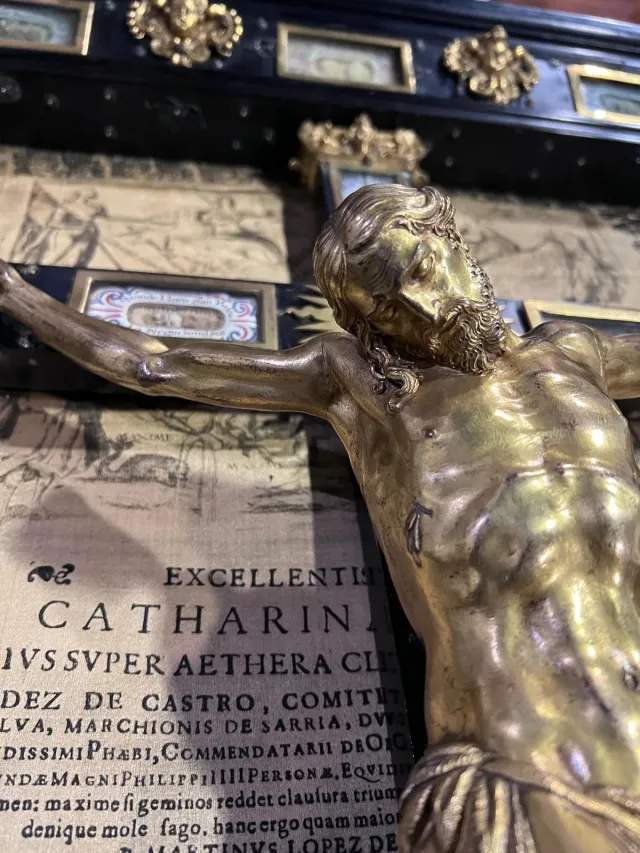
As for the image of Christ, it reflects the essential characteristics of the type created by the Italian artist Guglielmo della Porta. Thus, the piece demonstrates an excellent anatomical study, although from a thoroughly Mannerist perspective. The body seems to trace a slight 'S' that extends from the head, tilted to the right and looking toward the ground, and the position of the legs, together and turned to the left. As for its arrangement, the head of the Redeemer appears at shoulder height, just below the transverse crossbar, in the customary representation of the three nails. Another revealing aspect of the piece is the configuration of the loincloth, which is knotted on the right side and traces a slight descending diagonal. This element maintains an identical morphology to that of other crucified figures created by the Lombard artist.
Finally, noteworthy is the high degree of detail in the representation of elements such as the face, the beard, the hair, or the joints of the body. These and other details bear witness to the great mastery of the artist in creating a model of strong dramatic tension, capable of breaking with the rigidity characteristic of cold metal.
- Andrés González, P. (2020). “De convento a museo. Las colecciones de patronazgo femenino entre las clarisas”, en Ángel Zalama, M. e Andrés González, P. (eds.), Ellas siempre han estado ahí. Coleccionismo y mujeres. Madrid: Ediciones Doce Calles, pp. 95-111.
- Chamoso Lamas, M. y Casamar, M. (1980). Museo de Arte Sacro Clarisas de Monforte. Madrid: Caja de Ahorros de Galicia.
- Sáez González, M. (2018). “El VII Conde de Lemos transmisor del arte italiano en Galicia”, en Cruz Valdovinos, J. M. e Cañestro Donoso, A. Scripta artium in honorem prof. José Manuel Cruz Valdovinos. Alicante: Universidad de Alicante, pp. 740-749.
- Valle Pérez, J. C., y Fernández Otero, J. C. (1993). Os Museos da Igrexa en Galicia. Ourense: Xunta de Galicia.