Immaculate Conception
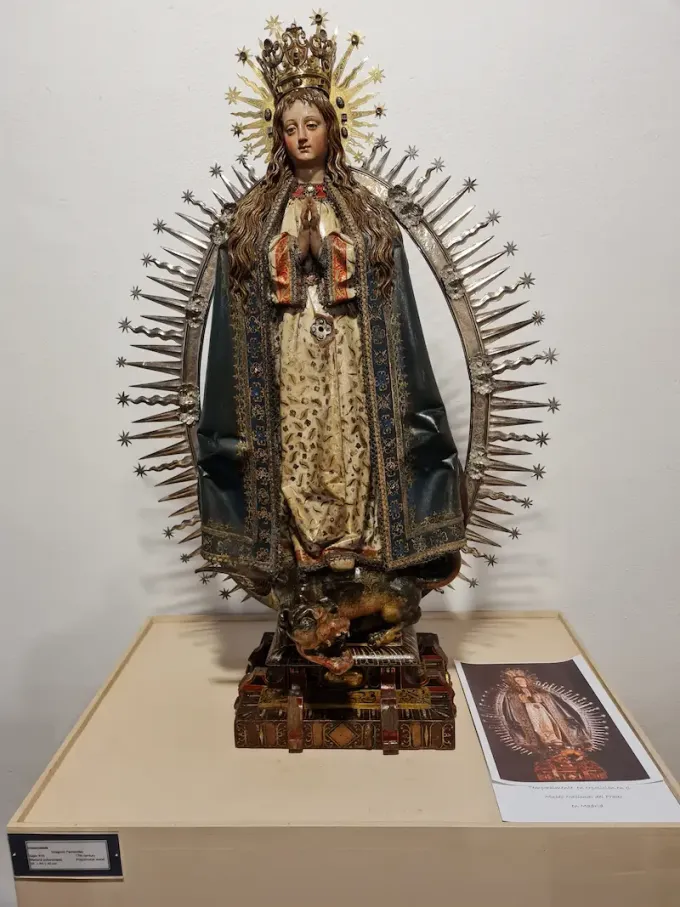
This Immaculate Conception was executed in the first third of the 17th century by the artist from Sarria, Gregorio Fernández. It is a polychrome wood sculpture that uses an iconographic style created by the artist himself, and which refers to a model with evident correspondences to the Immaculate Conception of the Cathedral of Astorga (c. 1626). Thus, we observe a crowned Immaculate Conception, with a serene face and in a praying attitude, with hands joined over the chest. As for the clothing, the image appears covered by a sky-blue, bell-shaped mantle with gilded details and a white tunic with schematic floral motifs. At her feet, she advances treading upon a dragon, and at the back, it is possible to observe the presence of a fine lunar crescent.
The image is completed by a halo made of silver and decorated with stars on its outer part and cherubs on its inner band. The piece is finished with a crown made of over-gilded silver and set gemstones, along with a nimbus that repeats the alternating star scheme present in the halo.
The entire ensemble is supported by a square-section wooden pedestal of two levels. The polychromy shows a decoration based on geometric forms that runs across the four sides of the piece.
Regarding its dating, this work was executed in the year 1629, following the aforementioned model of the Immaculate Conception of the Cathedral of Astorga (c. 1626). It is a piece practically identical to the one described in this entry, but of larger scale: 190 cm in height. However, despite the evident chronological discrepancy, the correspondence between both works could be due to the practice of making a smaller-scale preliminary model before creating the large-scale piece, which seems to have been a common practice by this artist. Consequently, it is possible to conjecture the existence of an Immaculate Conception of smaller dimensions than that of Astorga from an earlier date.
- Arias Martínez, M. (2024). Darse la mano. Escultura y color en el Siglo de Oro. Madrid: Museo Nacional del Prado.
- Chamoso Lamas, M. y Casamar, M. (1980). Museo de Arte Sacro Clarisas de Monforte. Madrid: Caja de Ahorros de Galicia.
- Lorenzana Lamelo, M.ª L. (1986) Aportación documental al estudio histórico-artístico de dos fundaciones monfortinas: el colegio de la Compañía y el Convento de las Clarisas. Santiago de Compostela: Universidad de Santiago de Compostela.